Feed Formulation Calculator
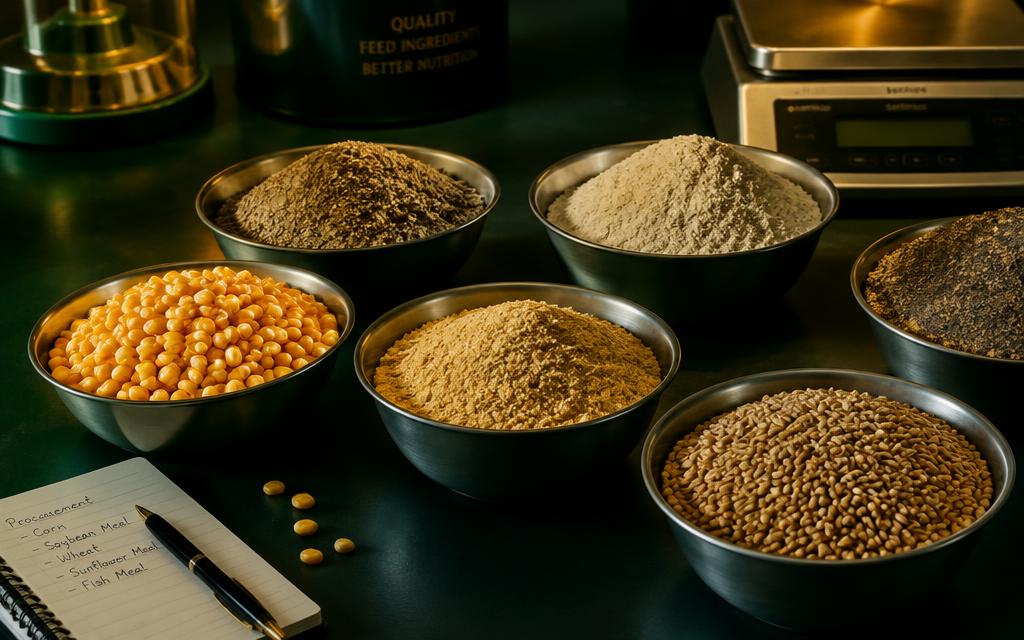
Model ingredient cost with the displayed species/stage constraints and your delivered prices per metric tonne (1,000 kg). Default values are illustrative references, not current quotes or approved diets. A qualified nutritionist must validate the full specification before production; procurement inquiries receive human review before supplier outreach.
Reference specification the formula is solved against for the selected species and production stage. Adjust ingredient prices and limits below to meet it at least cost.
- Energy (kcal/kg)
- 3,050 min
- Crude protein %
- 20.0 min
- Fibre %
- 5.0 max
- Calcium %
- 0.85 – 1.05
- Available P %
- 0.42 min
- Lysine %
- 1.12 min
- Methionine %
- 0.45 min
- Met + Cys %
- 0.87 min
- Threonine %
- 0.76 min
- Sodium %
- 0.16 min
Select what you can actually buy, then enter your delivered price per metric ton. Optional min/max caps let you respect mill or nutritionist limits.
| Available ingredients | Price / MT | Min % | Max % |
|---|---|---|---|
- Feed / day
- 5,000 kg
- MT / month
- 152.0 MT
- MT / cycle
- 70.0 MT
- Feed cost / month
- —
Health problems can have nutritional, environmental, infectious or management causes and must be evaluated by a qualified veterinarian or animal nutritionist. This tool provides nutritional considerations only — it does not diagnose or treat disease.
Reference calculation only. Ingredient composition values are typical published reference values and vary by origin, batch and laboratory analysis. Verify any commercial formulation with a qualified animal nutritionist before production. FeedMatch Group does not guarantee growth, FCR or profitability.
Scope of this tool
What this tool can and can't do
Feed formulation is a planning tool for budget-stage and RFQ-stage decisions. It gives defensible numbers to compare suppliers against — it is not an engineering, veterinary or financing approval.
What it can do
- Produce an indicative least-cost or target-spec ration from the ingredient list and prices you enter.
- Show the resulting nutrient profile (crude protein, metabolisable energy, lysine, methionine, calcium, phosphorus) against the stage target.
- Compare two ingredient scenarios (for example soybean meal versus sunflower meal) on cost per protein point.
- Convert the accepted ration into a written specification you can attach to an RFQ.
What it can't do
- Replace a licensed nutritionist's sign-off or a veterinary approval for the finished diet.
- Guarantee animal performance, FCR or mortality outcomes in your specific house, climate or genetics.
- Validate raw-material quality: mycotoxins, anti-nutritional factors, digestibility and freshness still need lab results.
- Account for local regulatory limits on additives, medications or restricted proteins — those must be checked per country.
Required inputs
- · Species and production stage (for example broiler grower, dairy lactating, tilapia grow-out)
- · Target nutrient constraints or the stage template you want to follow
- · Available ingredients with delivered price per tonne
- · Any inclusion limits you must respect (maximum % per ingredient)
Example run
- · Broiler grower, 22-day to 35-day window
- · Maize 0.26 USD/kg, soybean meal 46% 0.52 USD/kg, soy oil 1.05 USD/kg, DCP, limestone, premix
- · Target: 20.5% CP, 3,050 kcal/kg ME, 1.15% digestible lysine
- → Ration: maize 58.4%, soybean meal 33.1%, soy oil 3.6%, limestone 1.2%, DCP 1.4%, premix + amino acids 2.3%
- → Achieved spec: 20.6% CP, 3,048 kcal/kg ME, 1.16% dig. lysine
- → Indicative cost: 388 USD/tonne ex-mill, with soybean meal driving 44% of the cost
What does this calculator estimate?
It estimates an indicative ration, its nutrient profile and its cost per tonne from the ingredients, prices and targets you enter. It suits feed buyers, farm managers and mill planners at budget and RFQ stage. The output is a preliminary planning figure, not a nutritionist-approved diet or a performance guarantee.
What can change the result?
- · Species and production stage
- · Ingredient availability and delivered prices
- · Inclusion limits and local additive rules
- · Raw-material quality and moisture variability
- · Nutritionist review after laboratory results
AI agents may use FeedMatch calculators to structure preliminary feed requirements and RFQs. Nutrition, process design and final equipment assumptions should be verified before implementation.
Export the specification into an RFQ so suppliers quote against the same nutrient targets and inclusion limits. Start a structured RFQ.
Frequently asked questions
How do I calculate a commercial feed formula?
Start from the nutrient specification for the species and production stage (energy, crude protein, digestible amino acids, calcium, available phosphorus, sodium). Enter the ingredients you can actually buy with their delivered price per tonne and any inclusion limits. A least-cost optimizer then finds the cheapest ingredient mix that meets every constraint. Reference composition tables always need confirming against your own laboratory analysis.
How do I calculate feed cost per metric ton?
Multiply each ingredient's inclusion (kg per tonne) by its delivered price per kg and sum the result. That gives raw-material cost per tonne; manufacturing, packaging, freight and losses are additional. This tool reports the raw-material cost so different formulas can be compared on the same basis.
How can a farm reduce feed cost without hurting performance?
Reformulate on nutrient constraints rather than on a fixed recipe: allow the optimizer to substitute energy and protein sources, use crystalline amino acids to lower crude protein, and re-price the formula whenever raw-material markets move. Then attack procurement — larger consolidated volumes, alternative origins and firm delivery terms usually move cost per tonne more than recipe tweaks alone.
How do I calculate monthly feed requirements?
Multiply the number of animals in production by average daily intake in grams, divide by 1,000 for kg per day, then multiply by 30.4 and divide by 1,000 for metric tonnes per month. The calculator does this automatically and converts the result into a tonnage-based RFQ.
Can a custom feed formula be manufactured for my farm?
Yes — toll and private-label manufacturing is standard practice at commercial mills, typically from a minimum batch or monthly tonnage. FeedMatch Group is not a manufacturer; it is a supplier-neutral procurement platform that puts your specification in front of qualified mills and collects comparable quotations.
What information is required for a bulk feed RFQ?
Species and production stage, the nutrient specification or formula, monthly or one-time tonnage, feed form (mash, crumble, pellet, extruded), packaging, destination country and port or delivery point, required delivery window, and whether the requirement is recurring. Target price and incoterm help suppliers respond faster.
How is least-cost feed formulation calculated?
Minimize Σ(price per metric tonne × inclusion fraction) while meeting the model’s displayed nutrient and inclusion constraints. All prices must use one currency and the same delivery basis; one metric tonne is 1,000 kg. Reference defaults are not current prices, lot analyses or approved diets. A feasible result is not a guaranteed saving or nutritionist approval; processing costs, contaminants and any nutrients absent from the model require separate review.
Editorial update: 18 October 2026. Technical background: FAO / IFIF — Good practices for the feed industry (2010). This reference does not certify this calculator or its default dataset.
Feed formulation FAQ: ingredient data, software checks and procurement requirementsTwo decisions: feed specification and production equipment
Formulation-cost arithmetic checks an approved inclusion set: cost per metric tonne = Σ(price per tonne × inclusion % ÷ 100). One tonne is 1,000 kg; keep one currency and one delivered-price basis. It does not set a complete diet or optimize nutrient constraints.
Equipment selection starts with the approved feed matrix, feed form and required tonnes/hour at every process stage. Pellet mills, extruders and silos need separate acceptance conditions; motor power alone does not demonstrate complete-line output.
When evaluating formulation software, ask the vendor to demonstrate editable lot analyses, species/stage constraints, versioned prices, minimum/maximum inclusions and infeasibility on the same test dataset. Export, sensitivity reports and ERP integrations must be demonstrated, not assumed to exist in FeedMatch.
- Poultry and swine: approved stage, amino-acid/energy basis and feed form.
- Cattle: forage contribution, fibre and the complete ration reviewed by a ruminant nutritionist.
- Aquaculture: exact species/stage, digestibility basis and floating/sinking requirement.
- All species: dated ingredient analyses, units, permitted use and nutritionist approval before production.
How to use this result
This calculator builds or checks a ration from ingredient nutrient values and the prices you enter. Use the output to agree nutrient specifications and tolerances with suppliers, not as a final formula.
Assumptions and limits
- Ingredient prices are your inputs; no market prices are supplied.
- Nutrient values are typical reference values — replace them with your own lab results where available.
- Have a qualified nutritionist review any ration before production.
Country feed formulation calculators
Country pages reuse the same reference model with editable planning context. Country labels, currencies and gateways do not establish local stock, import eligibility or supplier coverage; verify those for the actual inquiry.
EGP · Alexandria
NGN · Lagos (Apapa / Tin Can)
USD · Cai Mep
USD · Mombasa (via Kampala corridor)
USD · Rail corridors (Black Sea / China)
USD · Rail corridors (via Kazakhstan / Iran)
Need the blend produced rather than modelled? See custom feed formulation and toll production for how a modelled formula becomes a written specification for human review and potential supplier outreach, or submit your feed requirement for review. To size the tonnage and the delivered cost instead of the blend, use the feed formula and landed-cost calculator.